Live mimicra.online 2026 · Python · FastAPI · Next.js · SaaS

Mimicra

Vibe Coding Project

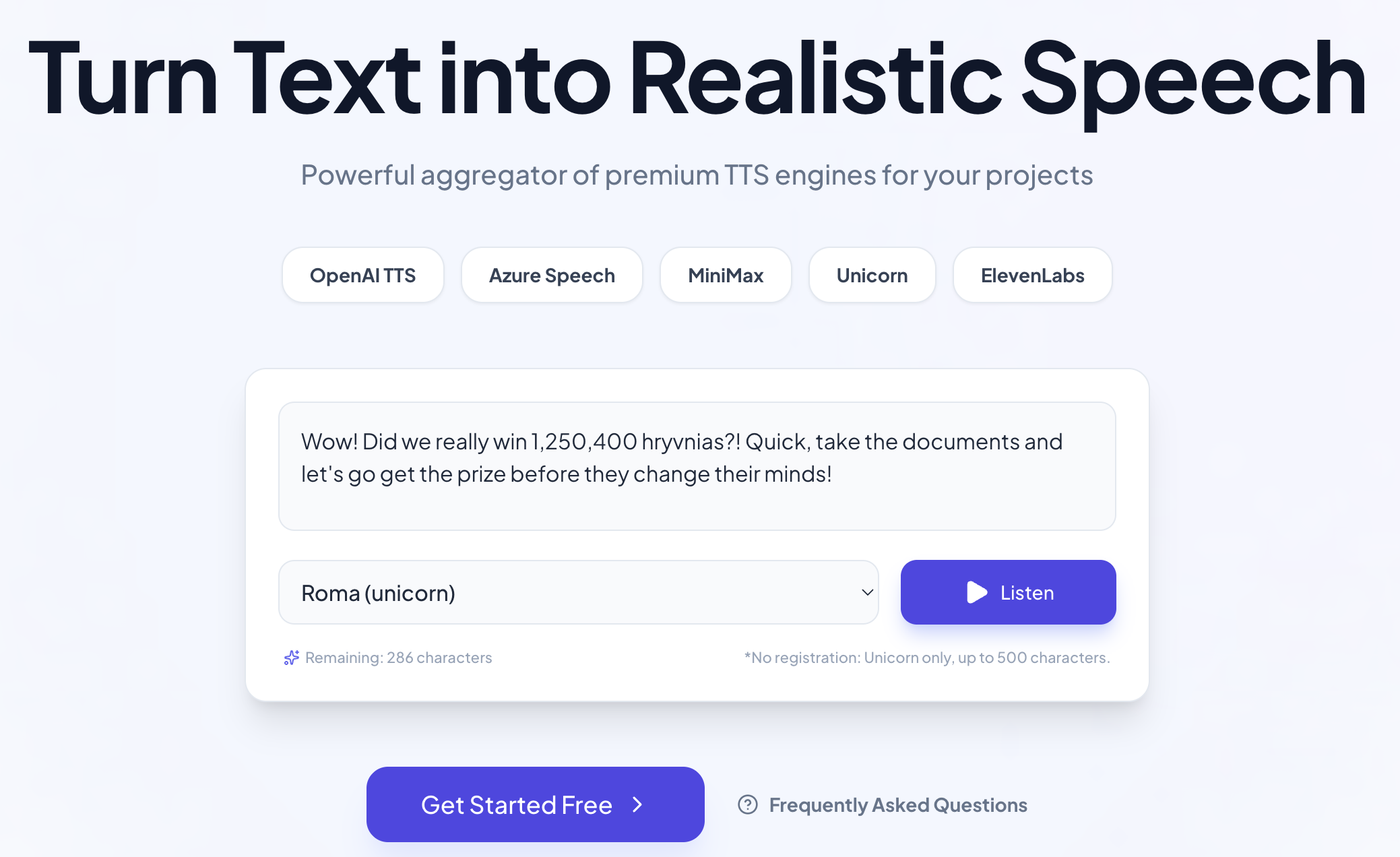
Production-ready multi-tenant TTS SaaS. Convert scripts into AI-generated audio via 5 providers, credit-based billing, async synthesis with webhooks, and a guest demo — all from a polished Next.js frontend. Built solo in ~1 month.

real data
383
completed generations
26 registered users
audio
~100
minutes of audio generated
37 MB stored on disk
providers
5
TTS providers, unified API
Unicorn · ElevenLabs · Azure · OpenAI · Minimax
roles
4
user roles, from guest to superadmin
credit billing · OTP auth
Mimicra
Overview

Full-stack SaaS, solo,
from scratch in ~1 month

Async Python backend (FastAPI + SQLAlchemy async), Next.js frontend, Celery for background jobs, credit-based billing with two payment processors (card + crypto), passwordless OTP login, and a full admin panel. Same API endpoints work from the browser via cookie and from automation via Bearer token.

Guests can try synthesis without registration. Registered users get 5,000 credits and access to all providers. Users with personal API keys bypass billing entirely.

Synthesis Engine

Three synthesis modes

01 / Sync & Async modes
Submit, poll, or get notified via webhook
Synchronous: returns audio binary directly, plays in browser immediately.

Async with webhook: submit job → receive transaction_id → poll or get notified on completion. Webhook delivery with retry: exponential backoff, 3 attempts, failure recovery.
Async jobs Webhook callbacks Retry + backoff
02 / Split Scenes mode
Script → multiple MP3s → ZIP archive
Splits script by regex scene separator. Synthesizes each scene individually with the same voice. Returns a ZIP archive with numbered .mp3 files — one per scene. Designed for long-form narration and audiobook production.
Regex split Batch synthesis ZIP output
03 / Controls & HQ mode
Speed, pitch, volume · 2× cost for HQ
Speed, pitch, and volume passed as SSML parameters to Azure; speed to OpenAI. HQ mode applies a 2× cost multiplier and triggers higher-quality synthesis on supported providers. Text chunking via TextSplitter for texts exceeding provider limits.
04 / Multi-Provider Architecture
Provider factory — swap without touching synthesis logic
Unicorn
Proprietary provider. Multi-key routing: per voice template → key assignment. System credentials stored in DB.
ElevenLabs
Standard and white/grey-label API. 700+ voices including cloning.
Azure
SSML-based synthesis, multi-locale, full pitch/speed/volume control.
OpenAI TTS
6 voices, speed control. Clean natural output for English narration.
Minimax
Integrated internally, not exposed to end users.
Billing & Access
05 / 4-Level Role System
From anonymous guest to superadmin
RoleAccess
guest No registration. Unicorn only, max 500 chars, 5 requests/day per IP.
user Registered. Credit-based. Access to all providers.
paid Same as user, paid subscription status.
admin Full access, zero cost, admin panel.
06 / Credit-Based Billing
Race-condition safe, auto-refund on failure
Every user starts with 5,000 credits. Cost = text_length × provider.cost_multiplier. Admins and own-key users pay 0. SELECT FOR UPDATE on the balance row prevents race conditions. Credits auto-refunded on failed generation. Credits expire after 365 days of inactivity.
WayForPay (card) WhitePay (crypto) SELECT FOR UPDATE Auto-refund 365-day expiry
07 / API Access
Same endpoints, two auth methods
Every registered user gets a personal ozv-XXXX API token. Auth supports both session cookie (browser) and Authorization: Bearer header (automation) — identical endpoints, identical logic. Rate limiting: 5 guest req/day per IP · 20 authenticated req/min.
08 / Two Celery Queues
Independent workers, independent scaling
priority_high
Paid users and priority jobs. Separate worker process.
default
Standard queue. Can scale workers independently of priority queue.
09 / Audio Lifecycle
Auto-cleanup, soft delete
Guest files deleted after 7 days. Registered user files after 14 days. Celery Beat runs cleanup daily at 3 AM UTC. Soft is_deleted flag before physical removal.
10 / User Preferences
JSONB, persisted across sessions
Last provider, voice, language, speed, pitch, theme, and UI language stored in a JSONB preferences column. UI restores full state on page load.
11 / Admin Panel
Full operational control
Block/unblock users, role changes, balance adjustments. Provider management: cost multipliers, enable/disable. Unicorn multi-key and template→key assignment. Global notifications and expense tracking.
Security

No passwords.
No plaintext credentials.

Passwordless login via OTP. All third-party keys encrypted. Login history tracked per session.

01
Passwordless OTP login — one-time codes via email through Resend. No passwords stored anywhere.
02
JWT cookie + Bearer tokenozv- prefix eliminates token ambiguity. Same endpoints handle both auth methods.
03
Rate limiting via fastapi-limiter + Redis on all public endpoints. IP + user agent registration fingerprinting for anti-abuse.
04
Login history tracking — IP and user agent recorded per session. is_blocked flag for instant suspension without deletion.
05
Sentry error tracking with traces, profiles, and PII enabled. Webhook delivery with exponential backoff retry.
Testing
Coverage areas
7 test
domains
Auth flow, token validation, cookie vs Bearer header
Admin security: role enforcement, superuser gates
Billing: hold, refund, insufficient funds, race conditions
Synthesis pipeline: sync, async, chunking, split scenes
Voice sync and provider credential management
TextSplitter edge cases and boundary conditions
Schema validation: HQ mode, advanced synthesis config
Stack & Infrastructure

Async all the way down.

FastAPI + SQLAlchemy async + asyncpg — no sync shortcuts. Traefik handles SSL automatically. Alembic runs migrations on every deploy. Celery Beat for scheduled cleanup and credit expiration.

Python
FastAPI
PostgreSQL
SQLAlchemy async
Alembic
Celery + Redis
Next.js
Docker
Traefik
Sentry
ElevenLabs
Azure TTS
OpenAI TTS
Resend
All projects Open Mimicra